Category: IBPoC Creators, Authors & Leaders
21 Things You Can Do on June 21

June 21 is National Indigenous Peoples Day in Canada. For generations, many Indigenous groups and communities have celebrated their culture and heritage on June 21 because of the significance of the summer solstice as the longest day of the year. Declared by proclamation in 1996, the day commemorates and celebrates the rich cultural heritage of Indigenous peoples. These events honour the diverse traditions, resilience, and contributions of Indigenous communities. This year, the BCGEU has shared 21 things that you can do on June 21st. I wanted to share this great resource with you:
1. Attend an event in your community such as the pancake breakfast and friendship walk at the Vancouver Aboriginal Friendship Centre or other events around the province listed here.
2. Support and honour Indigenous children by wearing orange. Orange represents the “Every Child Matters” movement which remembers the countless children whose lives were taken from them through the residential school system.
3. Read the recommendations of the United Nations Declaration on the Rights of Indigenous Peoples.
4. Listen to a CBC Reclaimed playlist or watch the documentary Rumble: Indians who rocked the world.
5. Read the 94 calls to action of the Truth and Reconciliation Commission.
6. Learn more about whose land you are on and learn a greeting in the traditional language.
7. Start listening to an Indigenous-created podcast.
8. Support and amplify Indigenous-owned businesses in your community.
9. Celebrate the history and contributions of two-Spirit peoples and other members of the LGBTQQIA communities during Pride celebrations.
10. Read and celebrate Indigenous authors and storytellers and Indigenous-owned booksellers.
11. Watch the APTN’s National Indigenous Peoples Day broadcast on June 21st, 2023.
12. Watch a film from the National Film Board of Canada’s catalog of over 200 Indigenous-created films.
13. Learn 21 things you may not have known about the Indian Act.
14. Stand in solidarity with land defenders such as Indigenous Climate Action, RAVEN and Indigenous Environment Network.
15. Learn about and follow these Indigenous trailblazers who are leaders in the arts, journalism, business, culture and share their stories on social media.
16. Challenge yourself to stop using language and talk that perpetuates harmful stereotypes. Here is a helpful guide
17. Do some independent learning on Canada’s history of colonialism. Thomas King’s An Inconvenient Indian is a good start.
18. Celebrate Indigenous artists at galleries such as the Bill Reid Gallery or other galleries that showcase the rich traditions of different nations.
19. Donate to Indigenous organizations or to residential schools’ survivor groups such as the Indian Residential Schools Survivors.
20. Share This Land: A companion resource for Early Childhood Educators to accompany Musqueum short films.
21. Keep learning- even when it’s uncomfortable.
This is just a start. Another great resource is 150 Acts of Reconciliation by Crystal Fraser and Sara Komarnisk. There are 365 days in the year when we can all learn, acknowledge, celebrate, and uplift Indigenous peoples and communities!
Heart Centered Learning: Rachel Cargle
Rachel Cargle is an Akron, Ohio born writer, entrepreneur and philanthropic innovation. Her work centres the reimagining of womanhood, solidarity and self and how we are in relationship with ourselves and one another. In 2018 she founded The Loveland Foundation, Inc., a non-profit offering free therapy to Black women and girls.
Her umbrella company, The Loveland Group houses a collection of Rachel’s social ventures including The Great Unlearn, a self-paced, donation-based learning community, The Great Unlearn for Young Learners – an online learning space for young people, and Elizabeth’s Bookshop & Writing Centre – an innovative literacy space designed to amplify, celebrate and honour the work of writers who are often excluded from traditional cultural, social and academic canons. I encourage you to check out her great work.
Heart Centered Learning: Jully Black
“As an artist, Jully is a truth teller and she represents how artists are a part of the conscience of society. She created an energetic shift in February when she changed one word in ‘Oh Canada’.” ~ RoseAnne Archibald, National Chief, Assembly of First Nations
Heart Centered Learning: Chef Babette
A seventy-two year old, world-class chef, fitness expert and motivational speaker, Chef Babette runs a successful Inglewood, California restaurant, Stuff I Eat, while also producing online cooking classes, and participating in health summit and speaking engagements all around the country. She is an amazing, inspirational human being who lives her life from a place of love. I hope that you will take some time to learn about her incredible journey.
Watch List: “Bones of Crows”
Bones of Crows is the first Indigenous and female-led produced, written, and directed drama about the residential school experience in North America. It was created by Marie Clements, a Canadian Métis playwright, performer, director, producer and screenwriter.
The film is a psychological drama told through the eyes of Cree Matriarch, Aline Spears. It reflects the protagonist’s survival of Canada’s residential school system and the impacts of systemic racism, starvation and sexual abuse. Bones of Crows unfolds over a one hundred year span; it captures an inter-generational fight for survival, as well as highlights the strength and resiliency of Indigenous peoples.
I had the privilege of attending a private screening of Bones of Crows earlier this week. Marie Clements and many of the cast members were there in person at the event. Not only was it deeply moving experience to watch the film but it was an honour to learn, first hand, about its creation. Every single Indigenous person who spoke was either a residential school survivor themself or knew a family or community member who had survived. The experience of being there, in that room, bearing witness to the truth of Canada’s dark past, is something that I will never forget.
Black History Month
Every February, people across Canada participate in Black History Month events and festivities that honour the legacy of Black people in Canada and their communities.
Historically, Black people have largely been ignored in the telling of mainstream Canadian history. Black History Month is a time to learn about these important stories and significant contributions.
The 2023 theme for Black History Month is: Ours to Tell. This theme represents both an opportunity to engage in open dialogue, and a commitment to learn about Black histories, successes, sacrifices and triumphs. I encourage you to start by checking out this great series 28 Moments of Black Canadian History by Unilearnal.
National Day for Truth & Reconciliation
Today is the second annual National Day for Truth and Reconciliation and Orange Shirt Day in Canada. It is both a day of mourning and reflection, as well one of action and hope for a better future ahead. I am honouring this day, in part, by highlighting a poem, “Wild West”, written by an Indigenous author, Cobra Collins.
Cobra is a Mohkínstsis-based mixed Indigenous and Metis poet. She has represented Vancouver on a national level at the Canadian Festival of Spoken Word, as well as collaborated with artists of different backgrounds for dance (Fluid Movements Arts Festival) and performance festivals (IKG 1 ! Live Performance Festival). She currently sits as Indigenous advocate on the Writers’ Union of Canada’s (TWUC) National Council. Cobra was also honoured to be shortlisted as a nominee for Calgary’s 2016 & 2018 poet laureate.
The Ungrievable
“One way of posing the question of who ‘we’ are … is by asking whose lives are considered valuable, whose lives are mourned, and whose lives are considered ungrievable.”
~ Judith Butler, Frames of War: When is Life Grievable?

Both the Canadian government, and the Province of BC, have declared September 19, 2022 a one-time Day of Mourning to mark the passing of Queen Elizabeth II. The swift and unified response demonstrates the immense value that our elected officials place upon the monarch’s life and legacy. It also reveals the ongoing strength of colonial ties between Canada and Great Britain. What this day highlights for me how our country continues to devalue Indigenous lives and how we are failing to live up to our promises of meaningful reconciliation.
September 30, 2021 marked the first National Day of Truth and Reconciliation. The Truth and Reconciliation Commission released its final report, with 94 Calls to Action, in December 2015. It took almost six years for the federal government to respond to Action #80, which called upon the federal government, in collaboration with Indigenous Peoples, “to establish, as a statutory holiday, a National Day for Truth and Reconciliation to honour survivors, their families and communities, and ensure that public commemoration of the history and legacy of residential schools remains a vital component of the reconciliation process.” Six years. In that time, the remains of more than 1,000 people, mostly children, were discovered in unmarked graves on the grounds of three former residential schools in two Canadian provinces.
On the first National Day of Truth and Reconciliation, Prime Minister Trudeau chose to surf with his family in Tofino, rather than spend the day with survivors and their families. Conversely, the Prime Minister immediately flew to London, England to attend the Queen’s lying-in-state; and on the National Day of Mourning, he will attend her funeral. The respect and reverence that he shows for one day over the other speaks volumes.
On this Day of Mourning, I will respect its intention to honour the legacy of a woman who gave her life to public service; and I will equally reflect upon the violence that colonialism continues to inflict upon Indigenous lives. I will read the 94 Calls to Action, and the Calls for Justice, in the Final Report for the National Inquiry into Missing and Murdered Indigenous Women and Girls. I will think about how I can, as a Canadian, do my part to move forward the calls to action and honour the thousands of lives lost.
A Day of Reflection and Remembrance
September 30th, 2021 marks the first National Day for Truth and Reconciliation. The creation of this day is in response to the 94 calls to action from the Truth and Reconciliation Commission. It is a new federal statutory holiday in Canada, marking the genocide that took place in our country, as well as the irreparable, intergenerational harm that residential schools continue to afflict upon Indigenous families and communities. It honours the survivors. Residential schools were government-sponsored religious schools specifically established to “kill the Indian in the child” and assimilate Indigenous children into Euro-Canadian culture. They ran for over over a hundred years, from the late 1800s until 1996: impacting over 150,000 children.
The Truth and Reconciliation Commission final report estimates that more than 4,000 indigenous children died in residential schools from either neglect or abuse. It is believed that this number is actually five to ten times higher, but the final total is unknown, due to poor record keeping by the churches, and unmarked mass graves.
Throughout the spring and summer of 2021, many new discoveries of children’s bodies were made due to the ground penetrating radar technology. The Tk’emlúps te Secwépemc First Nation in British Columbia discovered 215 unmarked graves on the grounds of the former Kamloops Indian Residential School. The Penelakut First Nation located 160 undocumented and unmarked graves in the province’s Southern Gulf Islands, once home to the Kuper Island Residential School; and 750 unmarked graves were discovered on the grounds of the former Marieval Indian Residential School in Saskatchewan.
September 30 is also Orange Shirt Day. This is an Indigenous-led grassroots commemorative day that honours the children who survived Indian Residential Schools and remembers those who did not. This day originates from the experience of Phyllis Webstad, a Northern Secwpemc (Shuswap) from the Stswecem’c Xgat’tem First Nation, on her first day of school, where she arrived dressed in a new orange shirt, and it was taken away from her. It has come to symbolize the stripping away of culture, freedom and self-esteem experienced by Indigenous children over generations. Orange Shirt Day invites Canadians to wear orange shirts on September 30th each year to honour survivors of residential schools, their families, and their communities.
Many Canadians view the residential school system as part of a distant past, disassociated from the current day. This is incorrect. The last residential school did not close its doors until 1996, and many of the leaders, teachers, parents, and grandparents of our Indigenous communities are residential school survivors. Although residential schools are closed, their effects remain ongoing for both survivors and their descendants who now share in the intergenerational effects of trauma and loss of language, culture, traditional teachings, and mental/spiritual wellbeing.
In Canada, 52.2% of children in foster care are Indigenous, but account for only 7.7% of the child population. This means 14,970 out of 28,665 foster children in private homes under the age of 15 are Indigenous: many of them permanently removed from Indigenous communities. Results from the 2011 National Household Survey also show that 38% of Indigenous children in Canada live in poverty, compared to 7% for non-Indigenous children. This stark reality illustrates the ongoing ripple effects of racists government policies, such as the Indian Residential School System, and the Indian Act.
On this first National Day of Truth and Reconciliation, every Canadians must take small, incremental steps on the path towards reconciliation. This can be done in many different ways, through learning, attending events, or donating to your community. It is a personal journey but one that we all need to commit to if we are to successfully move this country towards meaningful reconciliation with Indigenous peoples.
Here are some links that provide ideas for how you can take action today:
https://www.cbc.ca/news/canada/manitoba/community/personal-acts-reconciliation-1.4687405
“Just Mercy” by Bryan Stevenson

Bryan Stevenson is the visionary founder and executive director of the Montgomery-based Equal Justice Initiative (EJI). EJI is committed to ending mass incarceration and excessive punishment in the United States, challenging racial and economic injustice, and protecting basic human rights for the most vulnerable people in American society.
In his book, Just Mercy, Stevenson mixes commentary and reportage, against the true story of Walter McMillian, an innocent black Alabaman sentenced to death for the 1986 murder of an 18-year-old white woman.
Throughout the book, Stevenson provides historical context, as well as his own moral and philosophical reflections on the American criminal justice and penal systems. He ultimately argues that society should choose empathy and mercy over condemnation and punishment.
“Today we have the highest rate of incarceration in the world. The prison population has increased from 300,000 people in the early 1970s to 2.3 million people today. There are nearly six million people on probation or on parole. One in every fifteen people born in the United States in 2001 is expected to go to jail or prison; one in every three black male babies born in this century is expected to be incarcerated.”
Just Mercy is centered around unravelling McMillian’s case, revealing gross police and prosecutorial misconduct, while also weaving in stories of other death-row inmates. Stevenson does this to illustrate the common infringement of victims’ rights, inflexible sentencing laws, and practices of injustice that result in too many juveniles, minorities, and mentally ill people being imprisoned in the United States.
“We will ultimately not be judged by our technology, we won’t be judged by our design, we won’t be judged by our intellect and reason. Ultimately, you judge the character of a society . . . by how they treat the poor, the condemned, the incarcerated.”
Throughout the book, Stevenson writes about the histories of different marginalized groups. He describes the racial history of the United States, from slavery through Reconstruction, post-Reconstruction, Jim Crow, the Civil Rights Movement, to the current day. He argues that efforts to oppress and dominate black people have not ended, but have endured through new institutions and social practices; and mass incarceration, which disproportionately affects poor people and minorities, is the latest incarnation of systemic racial and economic violence.
“Proximity has taught me some basic and humbling truths, including this vital lesson: Each of us is more than the worst thing we’ve ever done. My work with the poor and the incarcerated has persuaded me that the opposite of poverty is not wealth; the opposite of poverty is justice.”
This is an incredibly well-written and powerfully presented book. I learned a lot by reading it and I highly recommend that you pick it up.
“Indian Horse” by Richard Wagamese
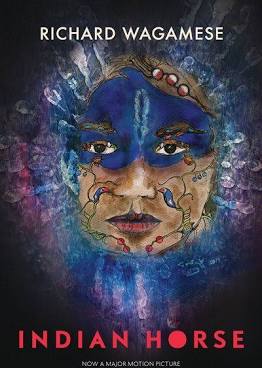
Indian Horse is a stark, yet incredibly beautifully written novel by Ojibway writer Richard Wagamese. As one of Canada’s foremost Indigenous authors and storytellers, Wagamese’s body of work includes six novels, a book of poetry (Runaway Dreams), and five non-fiction titles, including two memoirs and an anthology of his newspaper columns.
Indian Horse tells the story of Saul Indian Horse. It is set in northern Ontario in the 1950’s and 60’s. It begins with Saul, a former minor league hockey star, recovering in a treatment centre for alcoholism; he is chronicling his life experience as a means of facing his addiction. Although a deeply personal tale, it is also reflective of the wider intergenerational trauma experienced by thousands of Indigenous residential school survivors across Canada.
It begins in the northern Ontario where Saul lives off the land with his parents, grandmother and older brother Ben. Saul is happiest when learning traditional skills and family lore from his grandmother. Both of his parents are residential school survivors. They desperately hope that living in the wilderness, away from their community, will save their boys from being taken away to from them; but despite the family’s best efforts, the boys are eventually found, and taken against their will.
Once Saul arrives at St. Jerome’s Indian Residential School, his experience is harrowing: the students are subjected to beatings, sexual abuse and ritualized humiliation. The school is not designed to teach them to thrive in a new world but to break their spirits and erase their traditional ways of life. Although exceptionally difficult to read, Wagamese truthfully reflects the dire reality experienced by thousands of children across Canada: chronicling a dark chapter in history that should never be forgotten.
A form of hope arrives for Saul when an idealistic young priest introduces the older boys to ice hockey. The priest takes Saul under his wing, and allows him to play, even though he is younger than the other players on the team. The reader observes eight-year-old Saul exuberantly clearing the snow off the ice for the school team and practicing stick handling in the pre-dawn hours using frozen horse turds for pucks. Saul has a natural talent for the game and, like all great players, he visualizes complex plays before they unfold on the ice. He is soon outplaying the older boys, and he is eventually given permission to board with a family in Manitouwadge, so he can join the Native Tournament Circuit.
Saul finds love and acceptance in his new home: both with the Kelly family and his team, “The Moose”. He enjoys camaraderie with his fellow players both on an off the ice. But as Saul’s opportunities increase, so does his exposure to the overt racism and discrimination of the 1960s hockey world, and Canadian society. Saul’s rise up through the ranks of the minor-league is swift but it is also fleeting. He is stripped of his passion for the game and he ultimately walks away from his dream: adopting the nomadic life of a drifter. After many lost years, he hits rock bottom. With some support, he eventually finds his way home, rediscovering his connection to the land, his people, and himself.
Wagamese’s use of language throughout this novel is masterful. He is an incredibly skilled storyteller, with an uncanny descriptive power. I especially appreciated the visceral way that he captured Saul’s experience playing hockey; it helped me to understand the joy of the game. Throughout the book, I found myself stopping and rereading sections, just to take in its richness. Indian Horse is one of the most heart breaking and heart opening books that I have ever read. It is a testament to the resiliency of the human spirit and a stunningly beautiful piece of literature that everyone should experience.
 Breath by Breath