Finding My Centre

Woman Sitting On The Rock And Meditating In Yoga Pose. Back View

“The centre of the energetic body is recognized in various healing sciences and traditions. In the Chinese Qigong it is known as Dantian, the Japanese name is Hara, and in the Sufi tradition, the Kath.

The location of the Dantian is in the lower belly, just below the navel, sitting a few centimetres below the skin’s surface as an orb of organized energy. In modern society, so many of us are constantly flooded with expectations and emotions. We have lost the ancient wisdom of living from our true centre: where peace and calm exist, rooted in our inner wisdom and knowingness. When we operate from this place, we are grounded, patient and free of anxiety.

Next time you meditate or find yourself in a highly emotional or anxious state, close your eyes and focus on your Dantian. Breathe into it. Hold it in your mind. Feel to coming home to your true nature. You are here. You are enough.”

~ Zach Bush, M.D.

I have recently started to notice a deeply ingrained pattern. When I am faced with a challenging situation, I lose my grounding and I look outwards for the answers. What resource can I consult? What expert or trusted friend can give me advice? How can I confirm that my actions are the right ones? There is a lack of trust and deep feelings of fear that arise within me.

The other day, as I struggled with some difficult issues, I sought advice from a friend. Rather than offering me a solution to my problem, however, she counselled me to stop looking outwards and to start turning inwards. She wisely reminded no one can direct me on path except myself. Her guidance was to re-connect with my inner knowing. To seek the guidance of the quiet, steady core of myself that represents the integrated whole: the Dantian. She assured me that if you are still and you listen, it will show you the way.

Our society encourages action. We are told, from an early age, to be productive and efficient. The idea of sitting in stillness to seek answers from within is counter intuitive to this social conditioning. My instinct is always to “do something” but it is this frenetic doing that feeds into a feeling of groundlessness. Often, the most important thing to “do” is to stop and reflect: to create space for the solution to present itself. As I have been testing out this approach, I have been surprised at the answers that naturally arise from within. It is empowering to discover that I often know what to do in my body before I do in my mind.

Here is an exercise that I have been testing out recently to connect with my Dantian:

First, find a quiet space. Sit and close your eyes. Breathe deeply. Feel your hips on the chair. Settle them in. Imagine strong roots running down from your spine and hips into the ground: creating a solid, flowing connection with the earth.

Allow for any negative or fearful emotions to run from your body down into the rich, dark soil. Release all tension and anxiety. Feel it being received and absorbed. Breathe and sit quietly.

Now imagine the nourishing energy of the earth running back up these roots and into your body. Feel the loving, positive energy fill your whole being. Feel it centre and radiate in the space beneath your navel. Hold it there lightly. Breathe and sit quietly.

When it feels right, ask your inner wisdom the answer to your question. Listen and be still. Be patient and wait for the answer to present itself to you.

Tiny Steps to Transformation

martha beck

My inner perfectionist tells me that if I cannot fully commit to doing something, it is not worth doing it at all. If I want to learn French, I need to move to a French-speaking country; or if I want to be a writer, I need to quit my job and write full time. This story is very restrictive and limiting, as there is a low to zero chance that I can be successful. I cannot simply drop everything to focus on my passions without suffering serious consequences. And so…I do nothing. Nothing at all. My interests sit on a shelf for another year, waiting for the time and circumstances to be perfect, and the result is soul destroying.

There are life affirming interests and pursuits that call us from our deepest core. We are called to do them, as they give us joy and meaning. They reflect our unique reason for being here; and if they are not realized, in some form, it is like walking around with a blindfold on. I want to take my blindfold off, so I can fully engage in my life, and live a truly fulfilling existence.

Martha Beck is a best-selling author, life coach, and speaker who specializes in helping individuals and groups achieve greater levels of personal and professional success. She holds three degrees, a BA, MA and PhD from Harvard University. In addition to authoring several books, Beck is a columnist for O, The Oprah Magazine. Although Martha is a very accomplished woman, she has faced a lot of adversity along the way. This includes grappling with serious health issues, raising a child with Down Syndrome, and breaking ties with her Mormon community. In order to continue moving forward, despite facing many obstacles, Martha uses a technique called Turtle Steps.

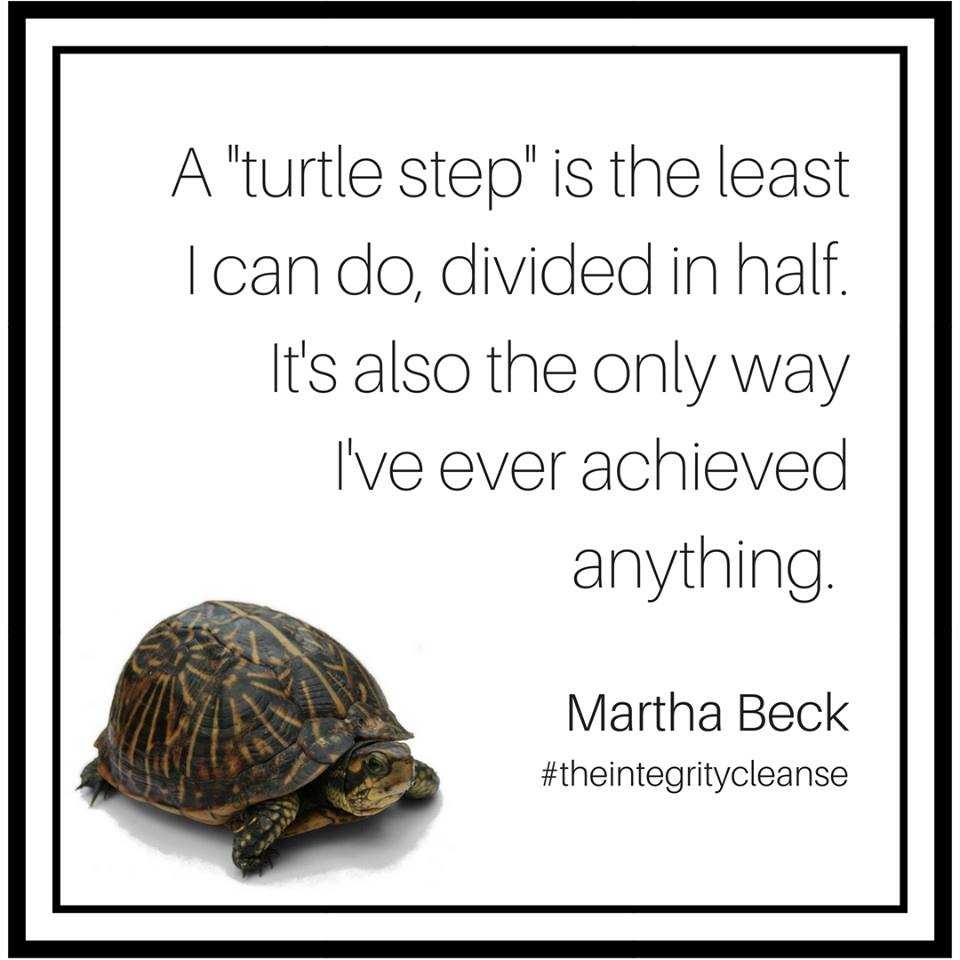
Turtle Steps are tiny, easy steps that you take towards reaching a goal. To create a Turtle Step, you identify your end goal, break it up into steps, and then cut each step into half. Continue cutting it into half until each step is so easy that you could do it in your sleep. Start with the taking the first easy Turtle Step. Continue onto the next one. And the next. Follow the step immediately with a reward of some kind. If you repeat the same behavior-plus-reward for four consecutive days, the behaviour starts to become a habit, and you will be able to sustain it with very little effort. This will eventually help you to accomplish your vision.

This approach strongly aligns with the work of James Clear and his recent book Atomic Habits. A habit is a behaviour that has been performed enough times to be done without thought; and daily habits are an embodiment of your identify. Every action you take is a vote for the person you want to become. The more votes you cast, the more likely you are to become that person. For example, if you make your bed every day, you are embodying the persona of a tidy person or if you read a page a day, you are embodying the persona of a reader. Once you believe in a certain identify, your daily actions start to naturally align with this belief.

We often overestimate what we can accomplish in a day and underestimate what we can achieve in a lifetime. James encourages you to focus on getting 1% better every day, rather than on making one big change. Habits can easily be overlooked, both good and bad. The difference between studying a language for five minutes a day or not, or choosing to eat a salad instead of a burger, seem like nothing in the moment. It is only when these habits compound over two, five, or ten years that you see the full impact of the 1% choices, for the better or worse. If you can start to internalize this concept, it will help you to see the importance of your daily actions.

The key is to make the change as easy as possible. James outlines this concept through his two minute rule. What can you do to initiate the habit? How do you automate the beginning of the new behaviour? He advises you to take your goal and scale it way down (e.g. if you want to become fit, commit to doing five push ups, every day for thirty days). Think of it as a gateway action or an entrance ramp. He argues that to establish a new habit, you must first master the art of showing up. A habit has to be firmly in place before it can be improved. Until you become the person who shows up every day, there is nothing to optimize. Once you fully believe in the new identity, you can upgrade and improve from there. James also advises never to miss twice. Missing once is a mistake. Missing twice is the start of a new habit; and habits are the compound interest of self-improvement.

Although the skeptic in me finds it difficult to believe that Turtle Steps or the Two Minute Rule are going to get help me achieve my goals, I know for a fact that I am not achieving anything by waiting for the circumstances to be perfect for full throttle engagement. I recently committed to five minutes of French practice every day by using the DuoLingo app on my phone. I have successfully accomplished my goal for the past ten days and it feels great. I have also made the commitment to sit down at my computer every morning for ten minutes and do nothing but write. If I can automate the habit of showing up at my desk, I can then focus on the effortful activity of writing once I am here. Although it is far from my dream of publishing a book, it puts me on the path to realizing that goal; and, more importantly, I am starting to identify myself as a writer. This is nourishing for my soul and worth its weight in gold.

Vacation Now

Traveler Girl Walking On Tropical Beach In Sunset. Vintage Photo

I love to go on vacation. After a few days of decompressing, I switch off and relax. I sleep. I read books. I laugh. I eat good food. I spend time with the people that I love. The sole focus of the day is enjoying the next meal or activity. There are no chores or obligations. There is a quality of light and spaciousness. It is fantastic and I cherish the experience.

When I return to “real” life, I often feel like I am on a hamster wheel. I go to work. I come home. I cook. I clean. I care for my daughter. I grocery shop. I run the laundry. I chip away on the never ending “to do” list (which seems to always be getting longer). I squeeze in time for friends and family. I catch my breath. Rinse and repeat.

I was speaking with a colleague recently about his long weekend. We swapped stories about how we spent our time. I shared how I had pulled apart my garage and reorganized it. He told me how he spent time being still. Still? I asked him for more details; and he shared how he schedules time in each week to be alone. No obligations. No activity. Just rest and stillness. I was intrigued.

He explained that the key to success is to schedule it in like any other activity and then fiercely protect it. It is easy for other obligations to feel more important; but when you are drained and exhausted, there is nothing left to give. Making time to rest is ultimately a gift to those you love (and yes, he does have a young child, and he is an independent parent, so time is precious).

I have been thinking a lot about his advice and my lack of ability to slow down during my “regular” life. Why can I do this for myself during a vacation and not as an ongoing practice? I realized that there is no real good reason except habit and commitment. It does not need to be a full afternoon or long period of time to be valuable and nourishing. A half an hour, here and there, is a good place to start; and it feels much more manageable.

I am going to start scheduling in “stillness” time in each week and see how I do. I will give myself some rules, such as no phone or computer. I will focus on activities that are quiet and introspective, such as reading, walking, listening to podcasts, knitting or zen colouring: all things that I really enjoy. My ultimate goal will be to cultivate a regular practice of rest and spaciousness, so I can bring this into my daily life, rather than waiting until I crash on vacation to restore and replenish.

If you enjoyed this post, please consider signing up for my monthly newsletter in the link below. You can unsubscribe at any time.

Processing…
Success! You're on the list.

The Power of Words

krysenclark

I came across a statement this week from Krystin Clark via social media: “I am not a single mother. I am an independent parent.” It stopped me in my tracks. As a woman who has defined myself as a single parent for the past three years, I was struck by this reframe. It is subtle yet powerful.

Self-definitions have a significant impact on well-being and state of mind. To identify as a single mother brings up images of vulnerability and fragility. A lone woman facing the world with her child. To identify as an independent parent is a statement of strength and assurance. It says: “I can do this on my own. I can stand on my own two feet.”

This pivot has caused me to stop and think about other ways I am limiting myself through self-definitions and self-talk. What are the stories that I assume to be true? How can I create space for something else? Words are either powerful tools or weapons, depending on the context; and they must be used with care. It is important reflect upon them regularly or we run the risk of boxing ourselves into a corner without even realizing it.

If you enjoyed this post, please consider signing up for my monthly newsletter in the link below. You can unsubscribe at any time.

Processing…
Success! You're on the list.
marie.png

Joy & Vulnerability

Freedom woman with open arms silhouette in sunrise against sun f

As I have written about in previous posts, I love the work of Dr. Brené Brown. I recently watched her new special “The Call to Courage” on Netflix and it is a great reflection of the her decades of research on shame and vulnerability and the path to living a whole-hearted life. I highly recommend that you check it out.

In watching the show, I was reintroduced to a concept that I have been thinking about all week. I would like to share with you, as it really resonated with me:

When we lose our tolerance for vulnerability, joy becomes foreboding.

When experiencing overwhelming feelings of love, we are at our most vulnerable; and it can trigger a dress rehearsal for tragedy. Brené outlines the example of a parent standing over his/her sleeping child. In that moment, the parent is filled with deep joy, followed by feelings of terror that something will happen to take the child away from him/her.

Worrying about things that have not happened does not protect us from pain. These thoughts only prevent us from truly experiencing the beauty of the moment before us. The next time you are worrying about “what ifs”, Brené suggests that you follow it with an acknowledgement that: “I am feeling vulnerable.” This creates space from the worry and brings you back into the present moment: revealing it to be a thought, not reality.

She encourages cultivating a regular practice of gratitude, as the most grateful people are the most joyful. When fear is triggered by joy, she suggests making a conscious effort to remember the things you are grateful for: then speak your gratitude or capture it in a journal.

Lastly, she outlines how to appreciate the ordinary moments. In a culture of scarcity, we are taught to seek the extraordinary; this leads us to miss out on the beauty of the ordinary moments unfolding before us on a regular basis. Take note of the small things that you appreciate about your family, work and friends: the fresh smell of your child’s hair after a bath; laughter at the family dinner table; the enjoyment of a cup of coffee first thing in the morning. It is these things that help us to connect with joy on a regular basis, appreciate the present moment, and lean into the discomfort of not knowing the future.

The good news is that joy, collected over time, fuels resilience—ensuring we will have reservoirs of emotional strength when hard things do happen; and the remedy for fear is gratitude.

If you enjoyed this post, please consider signing up for my monthly newsletter in the link below. You can unsubscribe at any time.

Processing…
Success! You're on the list.

Is it true, kind or necessary?

Little Girl Closed Her Eyes, Praying Outdoors, Hands Folded In P

My ten-year old daughter is facing friendship issues more regularly these days. Kids who have been in school together since kindergarten are forming groups and leaving one other out. They are telling tales and talking about each another behind their backs. Although considered to be “normal” adolescent behaviour, it is not ok. Little girls can be mean if left to their own devices and it is important for us to guide them.

I have been talking with my daughter lately about the fact that we cannot control other people’s actions but we can control our own. She finds this very frustrating, as she wants the world to be “fair”. I explain that her integrity is grounded in her own choices of words, actions and people. Nothing else. The rest is out of our hands.

In working through this issue with my child, I am reminded of the parable of three gates:

In ancient Greece, Socrates was visited by an acquaintance. Eager to share some gossip, the man asked if Socrates would like to hear a story that he had just heard about their friend. Socrates replied that before the man spoke, he needed to pass through the three gates.

The first gate, he explained, is truth. “Have you made absolutely sure that what you are about to say is true?” The man shook his head. “Well, I heard about it from the butcher who heard it from a client, and …”

Socrates cut him off. “You do not know for certain that it is true, then. Is what you want to say something good or kind?” Again, the man shook his head. “Well…not really. If our friend heard about it he would be very upset…”

Socrates lifted his hand to stop the man speaking. “So you are not certain that what you want to say is true and it is not good or kind. One gate still remains. Is this information useful or necessary to me?”  A little defeated, the man replied, “No, not really.”

“Well, then,” Socrates said, “If what you want to say is neither true, nor good or kind, nor useful or necessary, please don’t say anything at all.”

I have always liked this parable as it underscores the importance of being mindful about what comes out of your mouth before you speak. Too often words flow out and information is shared without thinking about the consequences. This is how people get hurt.

Although I cannot protect my daughter from friendship drama, I can support her as she navigates her path through it. Is it true? Is it kind? Is it necessary? Keep coming back to these three questions, my love. They will help to guide you through. They will move you away from the friends who gossip and towards the ones who choose kindness and integrity. These are one who will love you unconditionally, treat you with respect, and celebrate your unique and beautiful self. These are the friends that matter.

Maybe good…maybe bad…it’s all in your perspective

Rear View Man In Front Of Many Different Doors Choosing One. Dif

I have always appreciated the parable of the Taoist Farmer, as I think it offers a valuable perspective on life:

There was once a farmer in ancient China who owned a horse. “You are so lucky to have a horse to pull the cart for you!” his neighbours told him. “Maybe,” the farmer replied.

One day he didn’t latch the gate properly and the horse ran away. “Oh no! This is terrible news! Such terrible misfortune!” his neighbours cried. “Maybe,” the farmer replied.

A few days later the horse returned, bringing with it six wild horses. “How fantastic! You are so lucky. Now you will be rich!” his neighbours told him. “Maybe,” the farmer replied.

The following week the farmer’s son was breaking-in one of the wild horses when it kicked out and broke his leg. “Oh no! Such bad luck, all over again!” the neighbours cried.“Maybe,” the farmer replied.

The next day soldiers came and took away all the young men in the village to fight in the war. The farmer’s son was left behind due to his injury. “You are so lucky!” his neighbours cried. “Maybe,” the farmer replied.

In each instance, the farmer does not judge the action as either good or bad. It just is. I like this story as it reminds me that even when a difficult thing happens, there are various ways to look at it. There is much benefit in being open and curious to what comes, rather than reactive and resistant.  Even if something looks scary at first, you do not really know what it is or where it will lead you; a situation that looks unmanageable could reveal hidden strengths.

When my marriage fell apart three years ago, it broke me open. And although it was one of the most painful and frightening times of my life, it also offered me many gifts: gifts of community; gifts of insight; gifts of growth. I would never be where I am today without having made it through that experience, so I cannot think of it as only negative. It contained elements that were both negative and positive; and in many ways, I am grateful for it.

I have been reading Byron Katie‘s work lately to try to help inform my perspective and shape my response to challenging situations as they arise on a daily basis. She teaches about the importance of investigating the present moment and identifying the thoughts that are causing you suffering. This is done through asking four questions of inquiry:

Question 1: Is it true?
This question can change your life. Be still and ask yourself if the thought you wrote down is true.

Question 2: Can you absolutely know it’s true?
This is another opportunity to open your mind and to go deeper into the unknown, to find the answers that live beneath what we think we know.

Question 3: How do you react—what happens—when you believe that thought?
With this question, you begin to notice internal cause and effect. You can see that when you believe the thought, there is a disturbance that can range from mild discomfort to fear or panic. What do you feel? How do you treat the person (or the situation) you’ve written about, how do you treat yourself, when you believe that thought? Make a list, and be specific.

Question 4: Who would you be without the thought?
Imagine yourself in the presence of that person (or in that situation), without believing the thought. How would your life be different if you didn’t have the ability to even think the stressful thought? How would you feel? Which do you prefer—life with or without the thought? Which feels kinder, more peaceful?

Turn the thought around:
The “turnaround” gives you an opportunity to experience the opposite of what you believe. Once you have found one or more turnarounds to your original statement, you are invited to find at least three specific, genuine examples of how each turnaround is true in your life.

All of this speaks to the power of the mind and thought in shaping our world experience. We can cause ourselves great suffering or joy, all in the way that we choose to view a situation. And although I have a lot of work to do in shaping my own thoughts and reactions, it is empowering to have the tools to pull them apart and investigate them: rather than being at their mercy.

If you enjoyed this post, please consider signing up for my monthly newsletter in the link below. You can unsubscribe at any time.

Processing…
Success! You're on the list.

Podcast Passion

podcast

As I have talked about in earlier posts, I really enjoy listening to podcasts, especially when I am out walking or spending time working in the garden. There are so many good shows out there on virtually every topic. I particularly enjoy ones that delve into topics on writing, creative inspiration, health and well-being.

A few of my favourites at the moment are:

A few episodes that resonated with me recently are from the RobCast. He interviews his wife Kristen Bell on strategies for living with anxiety (episodes 226 & 227). She presents some great self-care suggestions, as well as perspectives on how to befriend the emotion, rather than push it away. I also really enjoyed the two Rob did called “An Anatomy of Restlessness” (episodes 230 & 231). He unpacks the feeling of restlessness and how it is an important message and catalyst for change. Lastly, I loved an interview that Rich Roll did with the screenwriter, Brian Koppelman, on how he broke through his own mental blocks to become a writer. It is really inspiring and contains some fantastic, actionable ideas for how to bring more creativity into your life, if you want it.

What are your favourite podcasts? I would love to hear what they are and why you love them.

Processing…
Success! You're on the list.

Learning How to Date…Again…

“Thankfully, relationships aren’t like baseball, where it’s three strikes and you’re out. The universe keeps pitching us new opportunities to redo, repair, and reinvent ourselves with another person.” ~ Dr. Stan Tatkin

Give Love Man Holding Red Heart In Hands For Love Valentines Day

I never enjoyed the dating experience as a teenager. It always felt awkward and uncomfortable to me. I think this is, in part, because I am an introvert: so making small talk with strangers is a challenge. I much prefer spending time with people who I know and love well and engaging in deep, intimate conversation. This is generally not a great fit for the superficial nature of the dating scene.

I met my ex-husband when I was nineteen years old; and we stayed together for twenty-one years. I was overjoyed at the thought of having found my special person so young and I loved the idea of staying with him ‘forever’. I never wanted to date again. Check!

For a variety of reasons, I found myself at the end of my relationship two years ago; and now here I am starting all over again.  After experiencing deep heart-break, it is hard to imagine re-entering the arena of love. The vulnerability required to play the game is truly intimidating. You have to bring your whole self to the dating experience; and this means taking a deep breath and jumping into the unknown.

To start the process, a friend of mine recommended that I look into the work of Dr. Stan Tatkin. His is a relationship expert and his work focusses on how to build secure, functioning relationships.  He draws on principles from neuroscience and attachment theory to first help you better understand yourself and then your potential partner. I am currently reading his new book, Wired for Dating. It is a great resource and I highly recommend it to anyone considering entering the dating scene.

The interview with Dr. Tatkin posted below, hosted on the podcast Relationship Alive with Neil Sattin, is a good capture of his work and overall approach:

I really appreciate Dr. Tatkin’s description of the various attachment types (anchor, wave or island). I found it to be very revealing and I now much better understand my own preferences and approach (I am a wave/anchor). Additionally, I like the traits that he describes of a secure functioning relationship. It provides me with a clear outline of what needs to be in place for a romantic partnership to succeed. I also love it because it is so relevant to parenting my daughter and nurturing a healthy relationship with her as she grows into adulthood.

Traits of a Secure, Functioning Relationship

Security: We protect each other.

Sensitivity: We are aware of each other’s needs.

Justice and Fairness: We quickly repair any hurts that occur.

Collaboration: We are in this together.

True Morality: What is good for me, is good for you.

Although I am still nervous about the journey ahead of me, I feel like I have some really good tools on hand now to help me enter into this experience with an open heart and mind. I will let you know how it goes!

If you enjoyed this post, please consider signing up for my monthly newsletter in the link below. You can unsubscribe at any time.

Processing…
Success! You're on the list.

TED Talks: The gift and power of emotional courage

Psychologist Susan David shares how the way we deal with our emotions shapes everything that matters: our actions, careers, relationships, health and happiness. In this deeply moving, humorous and potentially life-changing talk, she challenges a culture that prizes positivity over emotional truth and discusses the powerful strategies of emotional agility.

TED Talks: Poverty isn’t a lack of character; it’s a lack of cash

“Ideas can and do change the world,” says historian Rutger Bregman, sharing his case for a provocative one: guaranteed basic income. Learn more about the idea’s 500-year history and a forgotten modern experiment where it actually worked — and imagine how much energy and talent we would unleash if we got rid of poverty once and for all.