Something to Inspire

“If right now our emotional reaction to seeing a certain person or hearing certain news is to fly into a rage or to get despondent or something equally extreme, it’s because we have been cultivating that particular habit for a very long time. But as my teacher Chögyam Trungpa Rinpoche used to say, we can approach our lives as an experiment. In the next moment, in the next hour, we could choose to stop, to slow down, to be still for a few seconds. We could experiment with interrupting the usual chain reaction and not spin off in the usual way. We don’t need to blame someone else, and we don’t need to blame ourselves. When we’re in a tight spot, we can experiment with not strengthening the aggression habit and see what happens.“
Excerpted from: Taking the Leap: Freeing Ourselves from Old Habits and Fears by Pema Chödrön,
Listen List: The Jerry Cans “Ahead by a Century”
I love this Indigenous cover of the Tragically Hip’s song “Ahead by a Century” by Iqaluit’s The Jerry Cans, featuring throat singer Avery Keenainak. It is awesome. I have included the original below, so you can listen to both. Let me know what you think!
Heart Centered Learning: The Godfather of A.I.
Assume Nothing

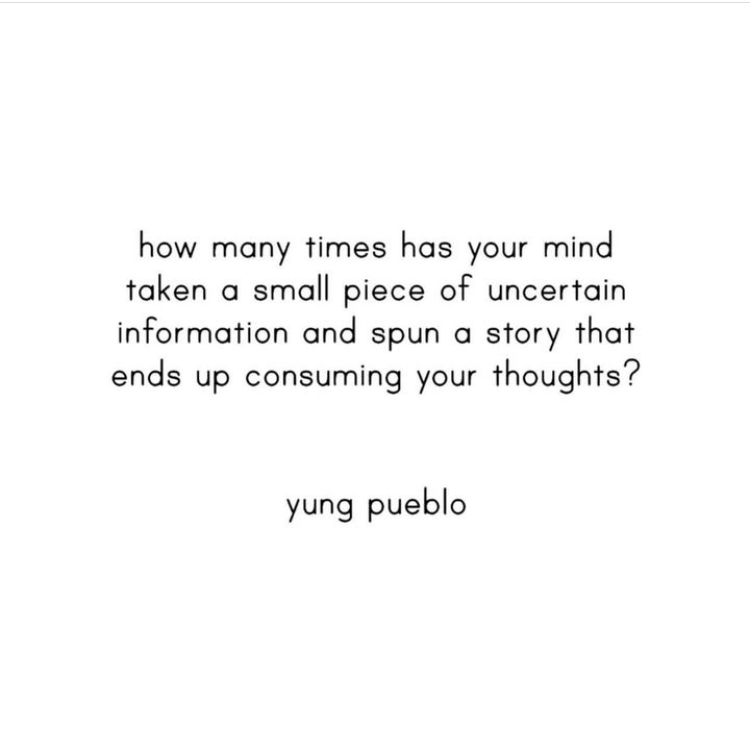
I create stories. I create stories about peoples’ intentions. I create stories about why things happen. I assume that I know the truth. This is a very human trait. It is the way our brains are wired: to make meaning out of chaos and confusion. But the reality is this is not ‘the truth.’ It is a perspective. It is a story. A concept knit together from fragments of information and weak assumptions. Rather than being helpful, it creates issues and causes harm.
I recently began to pay attention to this habit. I became an observer of the pattern. I started to ask myself some questions. What if I stop making assumptions and start allowing the discomfort of the unknown? What if I lean into curiosity and ask more questions? What if I invite difficult conversations and listen intently? What if I speak truthfully and allow for vulnerability? What if I refrain from analysis until I possess facts instead of guesses? What could that look like? I believe it could be absolutely transformative.
Something to Inspire

“The object isn’t to make art, it’s to be in that wonderful state that makes art inevitable.” ~ Robert Henri
Listen List: Harry Stiles, “Love of My Life”
Heart Centered Learning: Cobalt Red
Cobalt Red is the first-ever exposé of the immense toll taken on the people and environment of the Democratic Republic of the Congo by cobalt mining: as told through the testimonies of the Congolese people themselves. Activist and researcher Siddharth Kara has traveled deep into cobalt territory to document the testimonies of the people living, working, and dying for cobalt. To uncover the truth about brutal mining practices, Kara investigated militia-controlled mining areas, traced the supply chain of child-mined cobalt from toxic pit to consumer-facing tech giants, and gathered shocking testimonies of people who endure immense suffering and even die mining cobalt.
Cobalt is an essential component to every lithium-ion rechargeable battery made today: the batteries that power our smartphones, tablets, laptops, and electric vehicles. Roughly 75 percent of the world’s supply of cobalt is mined in the Congo, often by peasants and children in sub-human conditions. Billions of people in the world cannot conduct their daily lives without participating in a human rights and environmental catastrophe in the Congo. In this stark and crucial book, Kara argues that we must all care about what is happening in the Congo–because we are all implicated.
Something to Inspire

May God bless us with discomfort
At easy answers, half-truths,
And superficial relationships
So that we may live
Deep within our hearts.

May God bless us with anger
At injustice, oppression,
And exploitation of people,
So that we may work for
Justice, freedom and peace.

May God bless us with tears
To shed for those who suffer from pain,
Injustice, starvation and war,
So that we may reach out our hands
To comfort them and
To turn their pain into joy.

And may God bless us with enough foolishness
To believe we can
Make a difference in the world,
So that we can do
What others claim cannot be done.
Listen List: Jessia, “Nobody Hates You”
Heart Centered Learning: Rachel Cargle
Rachel Cargle is an Akron, Ohio born writer, entrepreneur and philanthropic innovation. Her work centres the reimagining of womanhood, solidarity and self and how we are in relationship with ourselves and one another. In 2018 she founded The Loveland Foundation, Inc., a non-profit offering free therapy to Black women and girls.
Her umbrella company, The Loveland Group houses a collection of Rachel’s social ventures including The Great Unlearn, a self-paced, donation-based learning community, The Great Unlearn for Young Learners – an online learning space for young people, and Elizabeth’s Bookshop & Writing Centre – an innovative literacy space designed to amplify, celebrate and honour the work of writers who are often excluded from traditional cultural, social and academic canons. I encourage you to check out her great work.
 Breath by Breath